Root rot in houseplants
Root rot is the most common way overwatering kills a houseplant. Here is how to confirm it, what you can still save, and how to prevent it.
Quick answer
A plant with root rot wilts even though its soil is wet, its lower leaves yellow, and its roots are brown, soft and smelly instead of white and firm. It starts in soil that stays too wet. If only some roots are rotten, cut them off, repot in fresh mix and water less; if most are dead, take healthy cuttings or throw the plant away.
What does root rot look like?
The plant wilts although the soil is wet, lower leaves yellow and brown, growth stalls, and the stem base may turn brown or black.
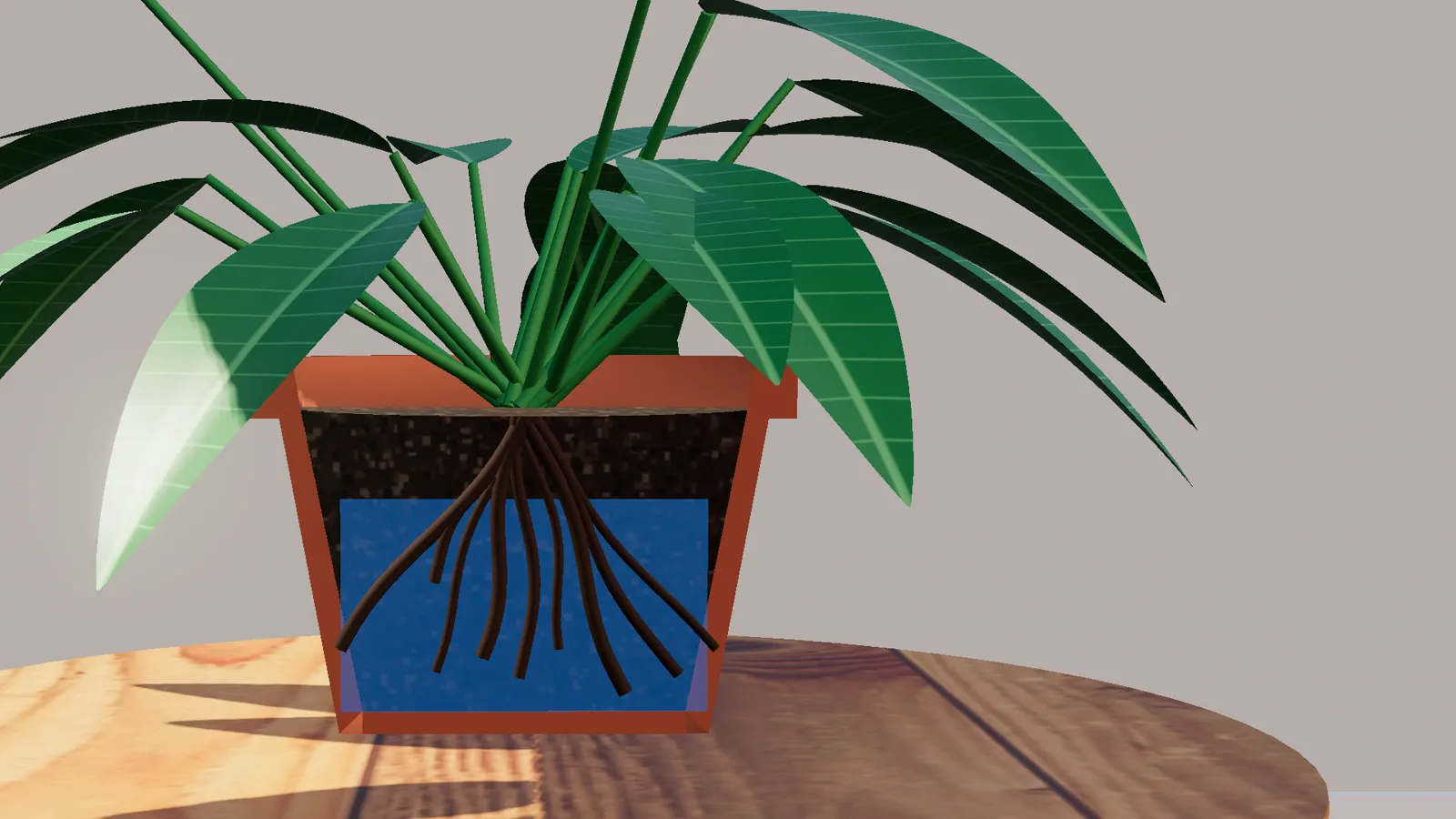
- Wilting in wet soil is often the first clue people notice.[1] If leaves stay wilted after watering, the roots are most likely rotten.[2]
- Bottom leaves go first. Wilting starts low and can move upward until the whole plant collapses.[3]
- Yellowing, browning and dieback of leaves, with poor growth.[4] Stunting and yellow or reddish leaves can look like a nutrient shortage.[1]
- A dark ring at the soil line. Stems may be girdled by brown or black tissue.[5]
These signs are easy to mistake for thirst, and watering a plant whose roots cannot take up water makes things worse.[6] That is why the next step is to look at the roots before you water again.[3]
How do I check the roots?
Slide the plant out of its pot. Healthy roots are firm and white; rotten ones are brown, soft and mushy, and may smell bad.
- Lift the plant out and tip away any water collected in the bottom of the pot.[7]
- Look at the color and feel the roots, using the table below.
- Note how much of the root system is affected: that decides what you do next.
| What to look at | Healthy | Rotted |
|---|---|---|
| Color | White[3] | Brown, reddish or black[3][5] |
| Feel | Firm, with many fine feeder roots[3] | Soft and mushy[3] |
| Smell | No bad smell | May smell bad[1] |
| When pulled | Stays whole | The outer layer slips off, leaving a thin thread;[8] much of the root system may stay behind in the pot[4] |
What causes root rot?
Soil that stays too wet. Waterlogged roots run short of oxygen and weaken, and water molds and fungi in the mix then attack them.
Excess water drives oxygen out of the soil, which damages the fine roots so they cannot take up water.[9] Overwatering is the main cause of death in potted plants.[6] Root rot organisms mostly attack plants already weakened by stress, and an overly wet growing medium is one of the most common stresses.[8]
The usual culprits are Pythium, Phytophthora, Rhizoctonia and Fusarium.[1] Pythium and Phytophthora are water molds, not true fungi.[10] Telling them apart needs a microscope or a lab, so for home growers the treatment is the same.[8]
Things that keep the mix too wet, and so set it up:
- Watering on a schedule instead of when the plant needs it.[3]
- Leaving the pot standing in water, which fills the air spaces in the soil.[11]
- A pot far too large for the roots,[12] or a mass of crowded roots that stops water draining.[13]
- Old mix that has broken down and compacted, letting less air reach the roots.[11]
- High fertilizer salt levels.[14]
Pythium is very rarely found in bagged soilless mixes; it is easily brought in on dirty tools or pots.[15]
Can a plant with root rot be saved?
Sometimes. With only a few rotten roots, trim them and repot in fresh mix. When most roots are dead, take healthy cuttings or discard it.
| What you find | What to do |
|---|---|
| A few soft, brown roots | Cut them out and repot in sterile mix,[5] perhaps in a smaller pot with drainage holes.[2] Then water less often.[8] |
| Most roots dark, soft and dead | Discard the plant.[5] If some stems are still healthy, take cuttings from those first.[4] |
| Roots fine, but the soil stays soggy | Empty the saucer, let the mix dry more between waterings, and check the drainage hole.[9][7] |
Be realistic: it may or may not be possible to save the plant.[2] Wisconsin Extension says throwing it out is often the best and cheapest option, and if you keep it, cut soil moisture.[1] It does not recommend fungicides for houseplants, because few are available to home growers and they are expensive.[1] For repotting steps, see how to repot a houseplant.
How do I stop root rot coming back?
Water by need rather than by the calendar, use a pot with drainage and fresh commercial mix, and never reuse soil from a rotted plant.
- Water when the soil says so, not on a schedule.[3] The Watering Helper sets a soil-check routine for your plant and pot.
- Use a pasteurized commercial potting mix, never garden soil, which often carries root rot fungi.[1]
- Use clean or new pots.[4] After a rotted plant, disinfect tools, surfaces and clay pots with a 10% bleach or detergent solution or alcohol, and do not reuse plastic pots.[1]
- Never reuse potting mix from a rotted plant, or water that drained from it.[1]
- Check new plants carefully before putting them with your others.[4]
- Skip gravel in the bottom of the pot: it does not help drainage.[16]
Spores spread in splashing water and moved soil,[5] so keep a plant with root rot apart from the rest until it recovers or goes.
Print the one-page houseplant care cheat sheet
Common questions
Is root rot the same as overwatering?
They are linked. Too much water cuts off the roots' oxygen and damages them, and water molds and fungi then attack the weakened roots. A plant with either problem looks the same from above, so check the roots.
Can root rot spread to my other plants?
It can travel in infested soil and splashing water. Keep an affected plant apart, never reuse its potting mix or the water that drained from it, and clean tools and pots after handling it.
Should I use a fungicide or hydrogen peroxide?
Wisconsin Extension does not recommend fungicides for houseplant root rot, and Clemson notes they likely cost more than a new plant. None of our sources recommends hydrogen peroxide. Drier soil and fresh mix are what they advise.
How fast does root rot spread?
Quickly. NC State says the fungi can spread through most of a root system in a few days, which is why prevention matters more than cure.
Can I reuse the pot after root rot?
Clay pots can be scrubbed and disinfected with a 10% bleach solution. Wisconsin Extension advises not reusing plastic pots, which are hard to disinfect properly.
Sources
Each numbered link in the text points to one of these pages, each opened and read on the date shown. How we check facts.
- Root Rots on HouseplantsUniversity of Wisconsin-Madison Extension. Checked .
- Extension Gardener Handbook, Chapter 18: Plants Grown in ContainersNC State Extension. Checked .
- Root Rots of HouseplantsIowa State University Extension and Outreach. Checked .
- Root Rots on Indoor PlantsUniversity of Maryland Extension. Checked .
- Houseplant Diseases & DisordersClemson Cooperative Extension, Home & Garden Information Center. Checked .
- Indoor Plants: WateringClemson Cooperative Extension, Home & Garden Information Center. Checked .
- How to help a poorly houseplantRoyal Horticultural Society. Checked .
- Prevent Root Rot Problems on HouseplantsIowa State University Extension and Outreach. Checked .
- Overwatered Indoor PlantsUniversity of Maryland Extension. Checked .
- Pest Notes: Houseplant Problems (Publication 74172)University of California Statewide IPM Program. Checked .
- How to grow houseplantsRoyal Horticultural Society. Checked .
- Repotting Houseplants Good Winter ActivityPurdue University Consumer Horticulture. Checked .
- How to repot a plantRoyal Horticultural Society. Checked .
- Success With Houseplants: FertilizationNebraska Extension in Lancaster County. Checked .
- PythiumPenn State Extension. Checked .
- Container Drainage OptionsUniversity of Illinois Extension. Checked .